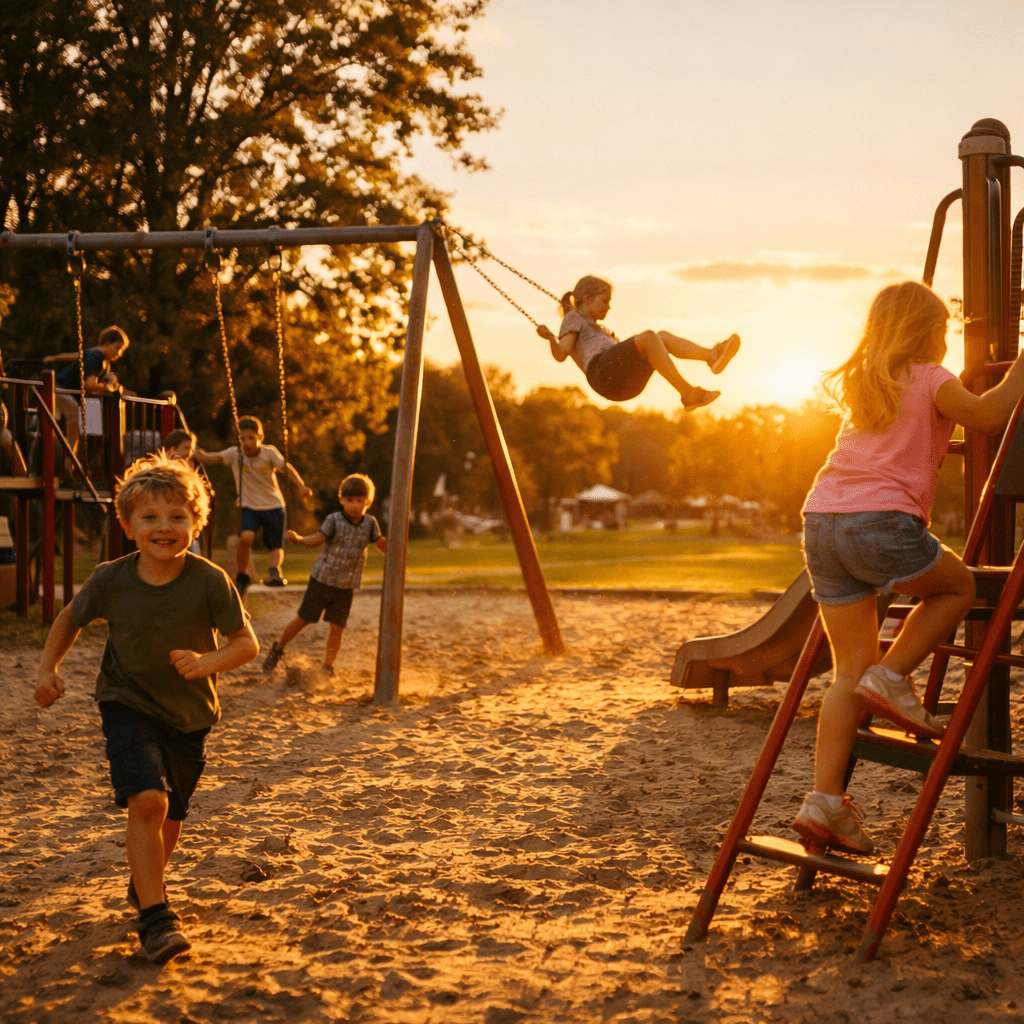
the other day, my child told me her friend at the playground didn’t greet her with the usual excitement.
she expected the familiar joy — the running, the smiling, the “oh hey, you’re here too, let’s play, do you want to go on the swing?”
instead, she got something quieter. something tired.
i told her that everyone has joyful days and grumpy days, and that her friend was probably worn out from school.
but later, the moment stayed with me.
i remembered noticing how the playground carries different moods during school months and holidays.
one carries the weight of routines and expectations.
the other carries uninterrupted play — unless someone remembers they have a packed lunch.
there’s something about playgrounds that lets children be fully themselves.
they climb, they swing, they flop into hammocks without thinking about how they look or who’s watching.
their moods are honest.
their energy is real.
they don’t hide their joy, and they don’t hide their exhaustion either.
they show up as who they really are — unfiltered, unmasked, no shows to put on, because there are no rules.
and then there’s school, and after‑school rooms, and structured spaces.
something shifts.
children learn to manage themselves.
to soften their edges.
to hold back parts of who they are so they can fit into the day.
and it makes me wonder —
if the only time children are allowed to be unfiltered, loud, joyful, messy, imaginative, chaotic, honest
is twenty minutes on a playground…
and the rest of their day is spent learning how to sit still, follow rules, suppress impulses, manage emotions,
and present the “acceptable” version of themselves…
so if the only time children are fully themselves is the smallest part of the day, what are we shaping them to become?
masked adults.
tired adults.
adults who forget how to play.
adults who forget how to rest.
adults who forget how to listen to their bodies.
adults who forget how to express their real feelings.
adults who forget how to be spontaneous.
adults who forget how to be unmasked.
and it’s strange — because adults love to say “never grow up,” as if childhood is this sacred, protected space.
but in real life, we rush children out of it.
we romanticise childhood while simultaneously rushing children out of it.
we say “never grow up,”
but we also say:
sit still
follow the routine
don’t cry
don’t be loud
share even when you don’t want to
say hi when you don’t want to
nap on command
eat on schedule
adjust
adapt
behave
we say “childhood is magical,”
but we give children the least amount of time to actually be children.
we say “play is important,”
but we treat it like a reward instead of a right.
and the heart‑breaking part is:
children learn the mask before they learn their own voice.
as soon as a child enters daycare at six months old, the world begins teaching them structure, rules, routines, expectations.
the very thing we claim to cherish — their freedom, their playfulness, their unfiltered joy — becomes the smallest part of their day.
we say “never grow up,”
but we build a world where growing up is the only option.
i’m learning to pay attention to these small moments —
they reveal more than we think.
 childofafricansoil
Leave a comment